

Essays on Gaia
Gaia is a satellite mission of the European Space Agency, launched in 2013, and which should be operational until about 2023. It is measuring the distances and motions of more than two billion stars in our Galaxy and beyond. It represents an enormous advance in the understanding of our Universe. As of early 2021, several thousand scientific papers have been written on its findings.
In these short 'essays', I have picked out some scientific highlights as they are emerging, or as they caught my attention. They make no attempt at a complete review of a given topic, and many will quickly become superseded by new results. But they offer a snapshot of the exciting discoveries that Gaia is making across all areas of astronomy.
Only a few references are included, and these are 'discreetly' hyperlinked for those who want to read more... where references appear in the form (Einstein 1908) or www.gaia.com, clicking on the text (even though not highlighted) should lead to the relevant online article.
Click on the "access PDF" icon to access the file, and on the audio file to listen to a short interview with one of the scientists involved.
14. Testing modified gravity
Gaia probes the weak-gravity regime
Dark matter has been invoked to explain various perplexing observations. Yet despite much experimental effort, there has been no detection to date. Could some modified theory of gravity provide an alternative explanation? Gaia is providing a probe in the weak gravity regime using wide-separation binary stars.
5 April 2021

13. The distance to the Pleiades
Gaia sets the record straight
The Pleiades star cluster, in the constellation Taurus, has been recognised as a group of stars since antiquity, and it has long played an important role in establishing the cosmic distance scale. The Pleiades distance provided a puzzling controversy for Hipparcos. Gaia has at last set the record straight.
29 March 2021

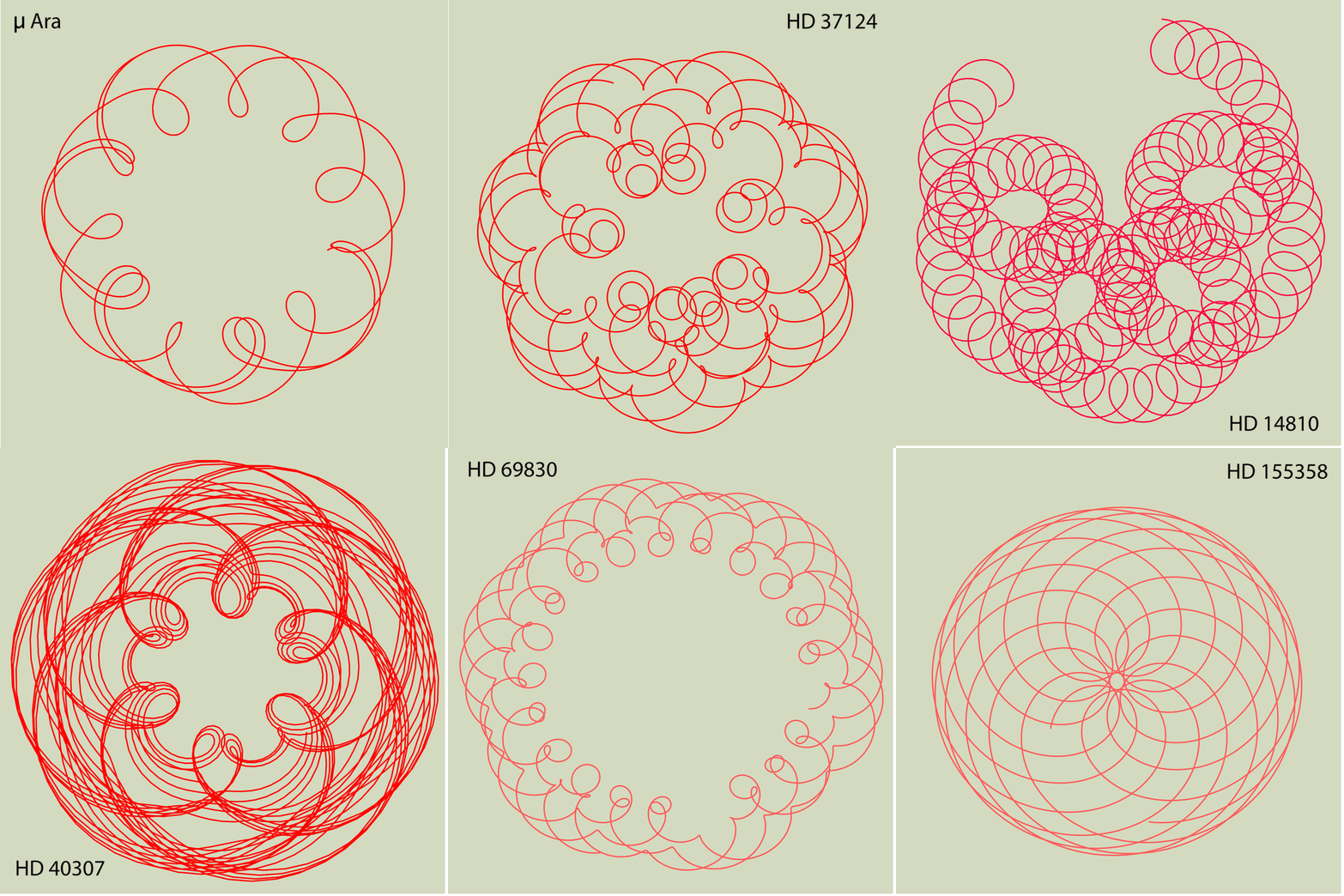
12. Planet mandalas
Beautiful fingerprints of planetary systems
Each planet around a star pulls on the star as it orbits, affecting the motion of the star itself. Multiple planets pull by different amounts, and with different periods. The result is that the star moves along a complex path through space, each planetary system with its own distinct 'fingerprint'. Gaia is measuring these remarkable movements.
22 March 2021
11. Astrometric microlensing
A manifestation of General Relativity
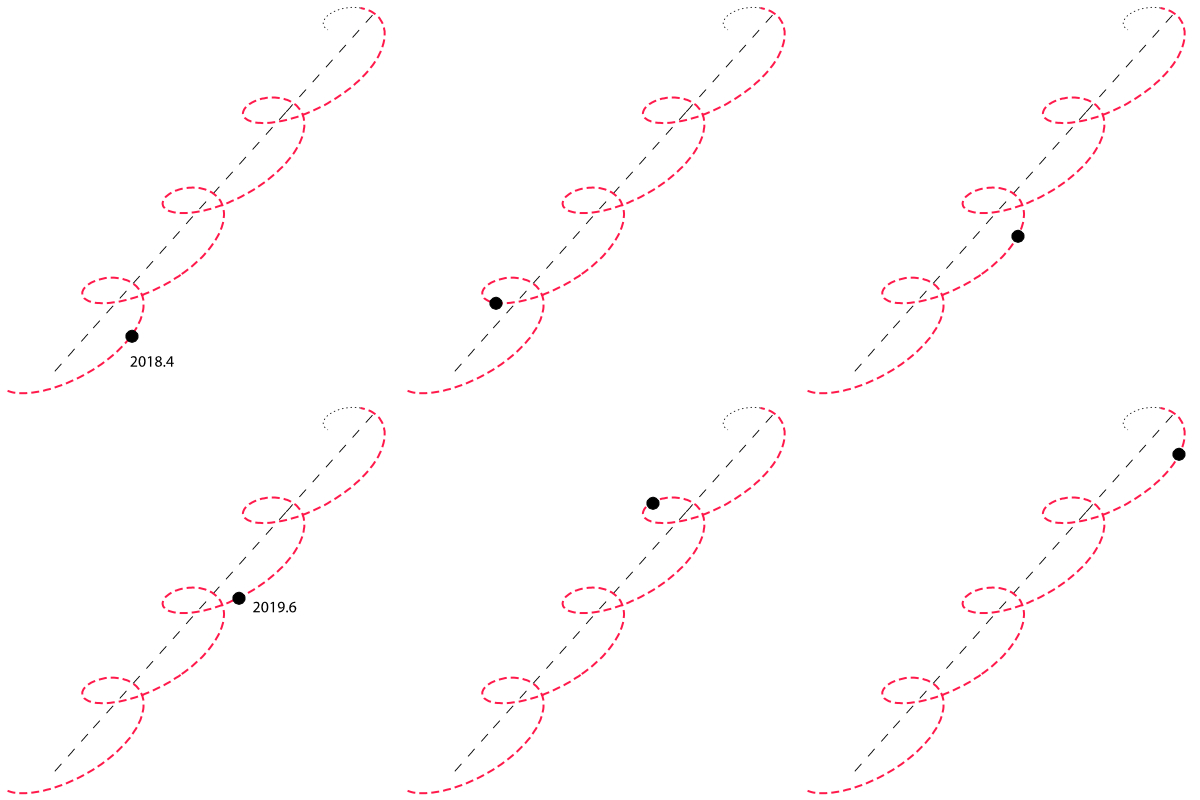
Gravitational microlensing is the bending of light due to a massive body. It occurs through the chance alignment of stars along the line-of-sight. The changing brightness of the background star gives a powerful technique for discovering exoplanets. For the first time, tiny shifts in the positions of the distorted images can also be detected by Gaia.
15 March 2021

10. Catalogue data releases
The data releases so far (to EDR3)
Gaia is more than six years into a possible 10-year data collection phase. Three data releases have been issued to date. Each successive catalogue supersedes the previous. Each comprises more observations, and an increased temporal baseline, and an improving accuracy of the astrometric parameters as a result.
8 March 2021

9. Gaia and GDP
Does it have any impact on economic growth?
Scientists are keen to emphasise that their contributions are essential for the advancement of human knowledge, and that they often have unexpected benefits much further down the line. Some economists are actually trying to quantify the returns on a country's investment made in the areas of fundamental or basic science.
1 March 2021

8. Why radial velocities?
And why they aren't easy to acquire
Classical astrometry measures star positions in two angular coordinates. But star motions along the line-of-sight can't be determined in this way. Great efforts were made to measure radial velocities from the ground for Hipparcos. Gaia is in the process of tracking more than a million of these radial motions directly from space.
22 February 2021

7. On-board detection for Gaia
How stars are detected on-board
Gaia uses a combination of advanced optical imaging and powerful onboard processing to detect every star that enters its field of view, down to a million times fainter than observable with the human eye. Each of these more than two billion stars are then tracked with its high-precision measurement system as the satellite scans the sky.
15 February 2021

6. Galactic tracers, by design
Establishing the mission goals
The design of the Gaia mission targeted very specific measurement goals, which were formulated in terms of limiting magnitude and astrometric accuracy. Gaia's limiting magnitude of around 20–21 mag, for example, was a requirement resulting from an examination of what types of stars, in different regions of our Galaxy, should be measured.
8 February 2021

5. An Input Catalogue for Hipparcos
Why it was needed for Gaia's predecessor
ESA's precursor to Gaia, Hipparcos, observed more than 100,000 stars in the early 1990s. The observing programme had to be pre-planned, in an effort that occupied many scientists for several years. That experience assisted the development of the techniques that Gaia uses today to detect everything that it observes directly on-board.
1 February 2021

4. Hipparcos: the push to space
The background to selecting Hipparcos
By the second half of the twentieth century the steady advance in the accuracy of stellar positions from the ground was running into a number of insurmountable barriers. The biggest problem was the bending and twinkling effects of the atmosphere. The answer was to carry out these measurements from space.
25 January 2021

3. A history of astrometry
Gaia in the big historical picture
The motions of the stars and planets perplexed the curious minds of the ancient world. Great advances in understanding our place in the Universe came in the Middle Ages, driven in part by the practical demands of navigation. Instrumental advances over the past few centuries have continued to drive scientific enquiry ever since.
18 January 2021

2. Why measure star positions?
For those with little knowledge of astrometry
The positions of stars in the sky vary minutely with time for a number of reasons. Accurately and repeatedly measuring them over months and years can discern tiny motions which prove central to understanding their nature, as well as providing a wealth of information on the structure and origin of our Galaxy and beyond.
11 January 2021
1. The measurement of angles
For those with little knowledge of astrometry
The basis of astrometric measurements is the accurate measurement of tiny angles that divide up the sky. Dividing a circle, whether on paper or on an imaginary sweep of the celestial sky, is a task well-posed in principle. Practical techniques for doing so aside, it is only necessary to agree on the unit of subdivision.
4 January 2021
