

Essays on Gaia
Gaia is a satellite mission of the European Space Agency, launched in 2013, and which should be operational until about 2023. It is measuring the distances and motions of more than two billion stars in our Galaxy and beyond. It represents an enormous advance in the understanding of our Universe. As of early 2021, several thousand scientific papers have been written on its findings.
In these short 'essays', I have picked out some scientific highlights as they are emerging, or as they caught my attention. They make no attempt at a complete review of a given topic, and many will quickly become superseded by new results. But they offer a snapshot of the exciting discoveries that Gaia is making across all areas of astronomy.
Only a few references are included, and these are 'discreetly' hyperlinked for those who want to read more... where references appear in the form (Einstein 1908) or www.gaia.com, clicking on the text (even though not highlighted) should lead to the relevant online article.
Click on the "access PDF" icon to access the file, and on the audio file to listen to a short interview with one of the scientists involved.
64. Solar system objects in DR2
New insights in dynamics and taxonomy
Hipparcos observed around 100,000 stars, but just 48 asteroids. Gaia is expected to determine highly accurate orbits and reflectance spectra for 350,000 solar system objects, permitting profound studies of their dynamics, structure, and taxonomy. Their properties will shed new light on the formation and evolution of our solar system.
21 March 2022

63. Catalogue validation
How confident should users be?
When making the successive Gaia data releases available to the world-wide scientific community, an important question is to what extent the positions, distances, proper motions, photometry, and radial velocities can be ‘trusted’? What sort of independent validation can be made before publication? Many tests are made, and I describe a few.
14 March 2022

62. Variability across the HR diagram
Which evolutionary states show variability?
Variable stars have long been recognised as offering deep insights into stellar structure and evolution. Similarly, the Hertzsprung–Russell diagram provides a quantitative visualisation of all stages of stellar evolution. Together with its empirical analogue, the colour–magnitude diagram, it has enabled many advances in stellar astrophysics.
7 March 2022

61. Discovering variability with Gaia
How is Gaia identifying variable stars
There are enormous numbers of known variable stars, of dozens of different types. Some variability is 'intrinsic', being due to the luminosity of the star itself changing with time. Others are 'extrinsic', meaning that something affects the stellar light on the way from the star to us. Gaia is, again, transforming the field.
28 February 2022

60. Scientific project management
Lessons can be passed on!
In this short introduction to my own experiences, I will argue that there are skill sets that a scientific leader should possess in order to best optimise the prospects of success, and that there are lessons that can be learned from previous space projects, and indeed from wider sociological studies of how people and teams best work together.
21 February 2022

59. Supernovae with Gaia
What they tell about stellar evolution
Supernovae are dramatic and violent end-points of stellar evolution, and several thousand should be detected. But the physics of the progenitor star, and the evidence that each supernova leaves behind, are also rich in diagnostics: of neutron stars, black holes, and millisecond pulsars. We look at some of this forensic evidence being discovered by Gaia.
14 February 2022

58. Einstein crosses
Rare new lensing discoveries
Amongst the 500,000 quasars being observed by Gaia, and the several hundred showing multiple gravitationally lensed images, we take a more detailed look at the curious quadruple-imaged quasars, how they arise, how they are being discovered in the Gaia data, and what they might tell us about black holes, dark matter, and the Hubble constant.
7 February 2022

57. Technology preparation for Gaia
Advanced technologies for Gaia
Why does ESA fund the development of space science missions? Why do some of these run over budget, and over schedule? And what steps were put in place during the Concept and Technology Study in the 1990s to ensure that the advanced technologies needed for Gaia would be available consistent with its target launch date of 2012?
31 January 2022

56. Interferometer or monolith?
What determined the choice?
While Gaia started life as a small interferometer, interferometry was eventually dropped – after detailed industrial design studies – for objective technological and associated cost/risk reasons. But I consider that, had Gaia not started as an interferometer, it would not have been accepted within ESA’s scientific programme in 2000.
24 January 2022

55. Wow!
How Gaia is contributing to SETI
The search for extra-terrestrial intelligence, or SETI, is motivated by the belief that intelligent life is likely to emerge under conditions similar to those on Earth. There have been many searches, with false alarms, unconfirmed events, and new celestial phenomena discovered along the way. Gaia is contributing to our ever-improving picture.
17 January 2022

54. Animations, stereos and fly-throughs
Animated imagery of the Gaia results
It is a challenge to explain the scientific importance of astrometry to a wider public. But the measurement of stellar distances and space motions in the vast quantities and accuracies provided by Gaia, is yielding compelling animations, stereo images, and fly-throughs of our Galaxy. I provide some examples.
10 January 2022
53. The scientific case for Gaia in 2000
The science case for Gaia at the time of selection
With the steady flow of scientific results now coming from the Gaia satellite, I look back at the mission's scientific case, prepared during the period 1997–2000. This formed part of the Concept & Technology Study Report, which was used as the basis for ESA's advisory structure's selection of the mission in 2000.
3 January 2022

52. Interplanetary navigation
Spacecraft in the solar system
Spacecraft sent out to orbit, land on, or simply fly past the planets and other bodies of our solar system rely on interplanetary navigation. At the basis of knowing both the target object's orbit, and the rendezvous vehicle's orbit, are accurate star positions. The recent spectacular fly-by of Ultima Thule used the latest Gaia results.
27 December 2021

51. Asteroseismology - and star distances
Understanding stellar interiors
Given that stars are usually seen as point sources, it is perhaps surprising that we can say anything at all about their internal structure and physical processes. The observational effects of shock waves propagating through them provides an important tool for probing their interiors. And distances provide an important constraint.
20 December 2021

50. The DIVA project
A post-Hipparcos contender for a space mission
As the Hipparcos project neared its completion in the mid-1990s, several groups around the world started to discuss possible follow-on missions. DIVA was an initiative led by German scientists, intended as a fast and cheap mission, exploiting advancing technology, and providing a bridge to the results expected from Gaia.
13 December 2021

49. Galactic rotation
New insights in our Sun's orbital motion
Stars in the disk of our Galaxy rotate around its centre. Our Sun participates in this general motion, orbiting the Galaxy in about 250 million years. Much about our Galaxy's origin and dynamics relies on an understanding of the detailed form of its rotation. Many issues complicate its determination, which Gaia is advancing.
6 December 2021

48. The risk of asteroid impacts
How Gaia helps to predict them
From time to time, the topic of near-Earth asteroids, and their potential for impact hazards to our planet, hits the scientific and popular headlines. Although still unprecedented, Gaia's original target accuracies could have predicted likely impactors 100 years hence, contributing even more to impact assessment and mitigation.
29 November 2021

47. The iterative solution: implementation
How the catalogues are created in practice
Formulating the mathematical description of the astrometric solution was one part of the challenge for the Gaia data processing. But its actual computer implementation was quite another. The solution adopted is to execute four distinct data 'blocks', which are optimised in memory and evaluated in a cyclic sequence until convergence.
22 November 2021

46. The iterative solution: formulation
How the catalogues are created in principle
Gaia gathers an enormous quantity of observations of a vast numbers of stars over several years. The goal of the data analysis on the ground is straightforward in principle: like solving a giant celestial jigsaw, the task is to find the astrometric parameters of each star best matching this gargantuan global set of observations.
15 November 2021

45. RR Lyrae variables
There are 140,000 of these important tracers
Like the Cepheid variables, although less luminous, the distinctive light curves of RR Lyrae stars allows their detection to large distances. Nearly 200 were included in the Hipparcos catalogue, although only one provided a meaningful distance. Gaia DR2 provides results for 140,784 RR Lyrae stars as faint as 20.7 mag.
8 November 2021

44. The Hubble constant from Cepheids
First hints concerning the 'Hubble tension'
The expansion of the Universe is a central concept in modern cosmology. Empirically, it is partly characterised by the local value of the Hubble constant. But 'early Universe' and 'late Universe' methods are in slight, but significant, disagreement. Gaia parallaxes of Cepheids are assisting the understanding of this so-called 'Hubble tension'.
1 November 2021

43. Cepheid variables
Hipparcos measured 280, Gaia 10,000
Cepheids are pulsating stars with periods of around 1–30 days. They play a crucial role as distance indicators, and they are important tracers of spiral arms and Galactic rotation. The Hipparcos catalogue contained just 280. The second Gaia data release contains 9575 Cepheids, of which 3767 are in the LMC, and 3692 are in the SMC.
25 October 2021
42. Surprises in the HR diagram
Remarkable gaps in the lower main sequence
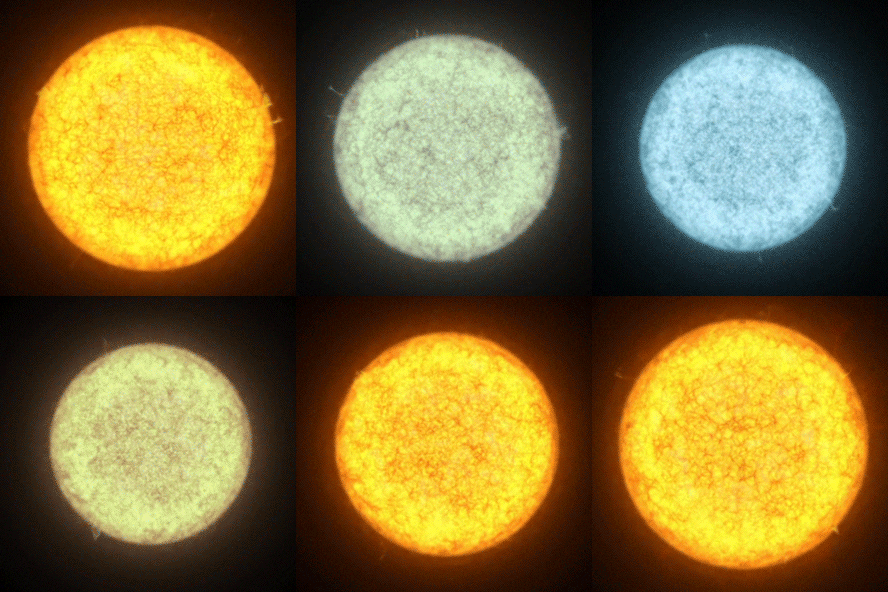
The vast numbers of accurate star distances being measured by Gaia yield Hertzsprung–Russell diagrams with unprecedented detail. The lower parts of the HR diagram show several surprising new features, with the convective-radiative transition evident in red dwarfs, and plasma crystallisation evident in white dwarfs.
18 October 2021

41. The age of our Milky Way Galaxy
Signs of mergers long long ago
Accurate distances out to 2000 parsec are yielding large samples of stars from our Galaxy's halo and from its thick disk populations. Their strikingly similar ages, from early in the life of the Universe, point to a common origin in which an orbiting galaxy merged with our own more massive progenitor.
11 October 2021

40. The distance of Omega Centauri
A new milestone in distance determinations
Globular clusters are amongst the oldest Galactic populations, and their origin remains unclear. But they are too distant for direct estimates of their parallaxes and ages to have been made in the past. Determination of the distance of Omega Centauri with Gaia represents a new milestone of distance measurements in astronomy.
4 October 2021

39. The Galactic anti-centre
A new probe of our Galaxy's components
Observations towards the Galactic centre probe its densest and most complex regions, with multiple populations superimposed: the thin and thick disks, star clusters, spiral arms, a bar, and the central bulge. In the anti-centre direction, star densities and interstellar extinction are lower, and the disk and halo can be more easily resolved.
27 September 2021

38. The Magellanic Clouds
Advances in understanding our neighbours
The Magellanic Clouds are two 'nearby' irregular dwarf galaxies, visible to the unaided eye in the dark skies of the southern hemisphere. They may be orbital companions to our Milky Way, or on a 'first approach' at the start of a grand galactic merger event. Hipparcos observed less than 50 stars in both systems. Gaia is observing more than 10 million.
20 September 2021

37. Ultra-wide binaries
Stellar binaries at the edge of disruption
Gaia is identifying tens of thousands of very wide and ultra-wide binaries from their highly accurate space motions. The resulting discoveries, and their space motions, are allowing great progress in understanding their formation, evolution, and the various processes that contribute to their eventual disruption.
13 September 2021

36. Science alerts
Some important needles in a huge haystack
Gaia monitors the precise magnitudes of every star a few hundred times throughout its lifetime. From these measurements, the mission is discovering enormous numbers of variable stars. Amongst them are novae and supernovae, as well as even more exotic variables. A powerful 'alerts' system is discovering many that deserve a closer look.
6 September 2021

35. Stellar flybys
Dislodging Earth impactors
Although interstellar space is very empty, noticeable effects due to nearby star passages can occur. A predicted consequence of a close approach is that the gravitational pull of the passing star can perturb the delicate equilibrium of the Oort cloud comets, with the possibility of an increased impact hazard on Earth.
30 August 2021

34. Perspective acceleration
A curious phenomenon in Euclidean geometry
For a fixed space velocity, a star's proper motion varies inversely with its distance. However, the tangential velocity changes due to the varying angle between the line-of-sight and its space velocity. The two effects result in a changing proper motion and, for a few nearby stars, an apparent acceleration of the star's motion on the sky.
23 August 2021

33. Nearby stars
A huge advance in this local census
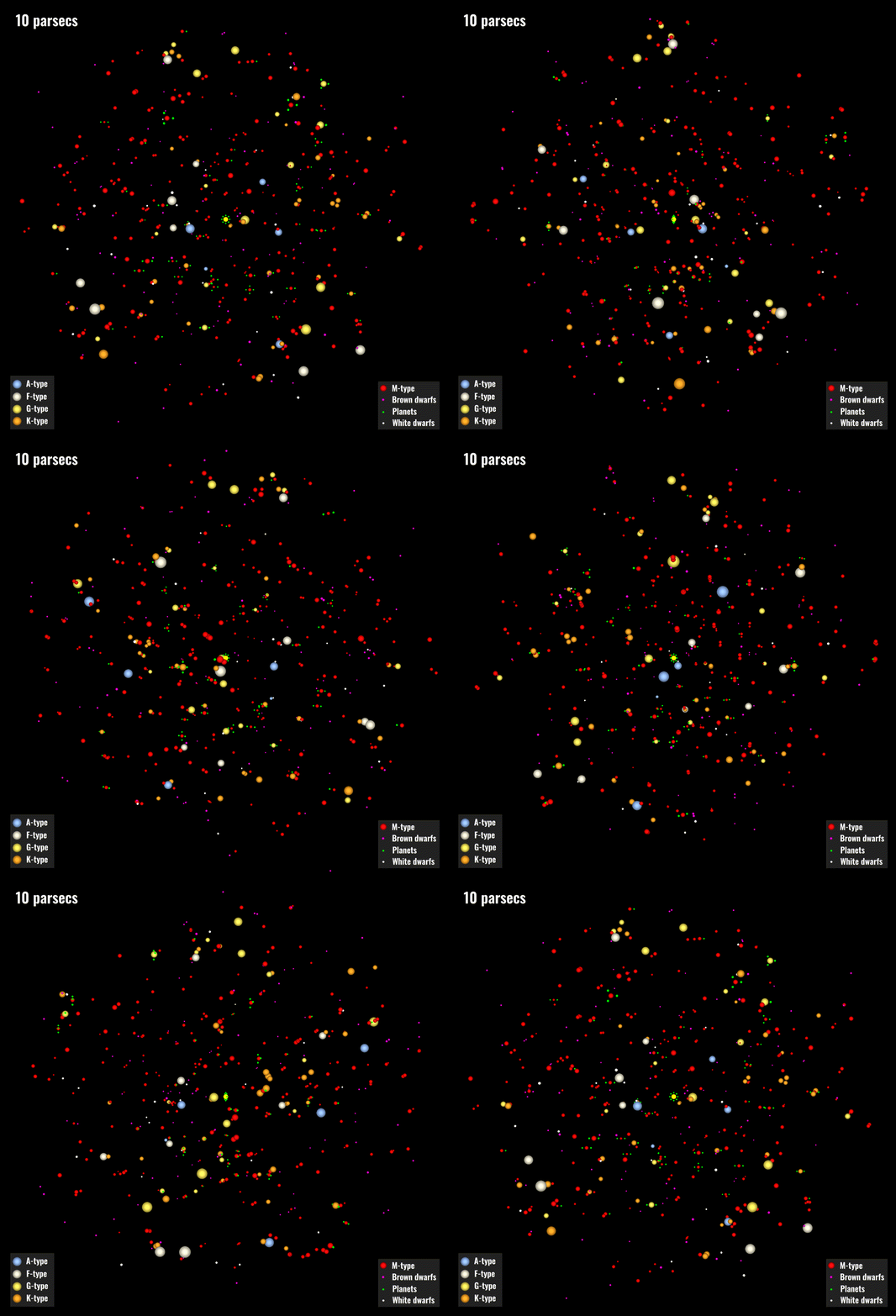
Surveys of our solar neighbourhood provide the foundations for defining our Galaxy's stellar luminosity and velocity distributions, the occurrence of binary stars, and the nature of many other types of objects, including brown dwarfs, white dwarfs, and exoplanets. Gaia is revolutionising this knowledge [gif courtesy: galaxymap.org].
16 August 2021
32. Aberration and Galactic rotation
New discoveries in a fundamental field
As the Earth orbits the Sun, star positions change due to the combination of the Earth's velocity, and the speed of light arriving from the star. The effect is already at levels imperceptible to the human eye. But a million times more sensitive still, Gaia has recently detected a similar effect due to the Sun's 250 million year orbit around the Galaxy.
9 August 2021

31. The motion of dwarfs spheroidals
Motions of objects in the Local Group
Dwarf spheroidal galaxies are small, low-luminosity galaxies comprising old stellar populations. By the late 1990s, their rarity seemed to be in conflict with the 'Lambda cold dark matter' cosmological model, which predicted that massive galaxies like the Milky Way should be surrounded by many dark matter dominated halos.
2 August 2021

30. The motion of globular clusters
Measuring their space motions
The space motions of globular clusters and dwarf spheroidal galaxies depend on our Galaxy's gravitational potential, and therefore its mass distribution. Together with knowledge of their chemistry and ages, these provide strong constraints on theories of formation of our Galaxy, including when and how the halo and disk actually formed.
26 July 2021

29. White dwarf surveys
Important objects in huge numbers
White dwarfs are of great importance for theories of star formation and evolution, of degenerate matter at extremely high density, for distance scale determination, and for understanding planet survival beyond a star's main-sequence lifetime. Pre-Gaia, known numbers were around 10,000. Gaia is in the process of characterising some 100,000.
19 July 2021

28. Solar activity - and dark matter?
Some speculation on dark matter
The rotation of the Sun is central to the two main hypotheses which try to explain the 11-year solar activity cycle: attributable either to a turbulent dynamo operating in or below the Sun's convection envelope, or to a large-scale oscillations of a fossil magnetic field in its radiative core. Some particularly speculative ideas could be tested with Gaia.
12 July 2021

27. The celestial reference frame
Defining the reference system
An absolute reference system is as central to Gaia as it was for Hipparcos, and the accuracy for the link correspondingly more demanding. But Gaia's limiting magnitude, at 20–21 mag, allows very large numbers of quasars to be observed by the instrument itself. And this means that the problem can be tackled much more directly.
5 July 2021

26. Polar motion
The wobbling Earth
The Earth's rotation axis moves, on timescales ranging from years to millennia, as a result of various external and internal forces. The wobbling motion of the Earth has been characterised, back to about 1900, by re-examining star measurements using the Hipparcos star positions. Further insight could be possible with Gaia.
28 June 2021

25. The origin of Oumuamua
Origin of an interstellar visitor
The astronomy world was captivated by the announcement of an interstellar traveller in October 2017. Named Oumuamua, from the Hawaaian for 'scout', it was discovered crossing the solar system some 40 days after its closest approach to the Sun. Gaia is in the process of pin-pointing its progenitor star system.
21 June 2021

24. Occcultations of Europa and Triton
Applications to bodies in our solar system
A stellar occultation occurs when a solar system object passes in front of a star. The brightness drop can be used to determine the occulting object's size and shape, the presence of an atmosphere around it, and structures such as rings or moons. Gaia is allowing occultation events to be accurately predicted in much larger numbers.
14 June 2021

23. The Maunder minimum
Probing Earth's climate
A particularly cold period in Europe, which caused great hardship, was a 70-year interval from around 1645–1715, today known as the 'Maunder Minimum'. Hipparcos made some first steps in establishing whether this sort of behaviour is common in solar-type stars. Further progress can be expected with Gaia.
7 June 2021

22. Hypervelocity stars
These strange objects get more mysterious
Hypervelocity stars are a rare and exotic type of star, racing through our Galaxy with velocities of 500–1000 km per second or more. How did they acquire these enormous speeds, how and where were they formed, where are they going, and what can they tell us about the structure and origin of our Galaxy? Gaia has all the answers!
31 May 2021

21. Measuring exoplanet radii
Gaia pins down the sizes of vast numbers
An accurate exoplanet radius, together with its mass, yields the planet's mean density, and a broad categorisation of its nature. Combined with periods and host star properties, this leads to great insights into both the physics of planetary atmospheres and interiors, and the physics of planet formation and evolution. Gaia is transforming the field.
24 May 2021

20. The Hyades star cluster
Our nearest clusters in three dimensions
The Hyades star cluster is the nearest open cluster to the Sun, at around 45 pc. Extending over about 20 degrees, it has played a central role in establishing the cosmic distance scale. Gaia has more than doubled the number of previously known members, built up over more than a century.
17 May 2021

19. How many exoplanets?
A huge number are on the way
The discovery of the first planets beyond our own solar system was a major landmark in astronomy. The first discoveries, in 1995, were proof that planets indeed existed around other stars, and that they might even be rather common. Today more than 4000 are known. Gaia should discover several tens of thousands.
10 May 2021

18. The origin of OB associations
New findings on the origins of star systems
There are a couple of dozen clusters, moving groups, and OB associations within about 150 pc of the Sun. The Gaia results are pointing to a new hierarchical picture of star formation, in which stars are formed across a continuous density distribution throughout molecular clouds, rather than exclusively within clusters.
3 May 2021

17. Solar siblings
Searches for our birth cluster
There are hints that our Sun was born in a star cluster, of perhaps a thousand other stars. But was it, instead, born in isolation? If it was part of a larger cluster, where are the other members now? Gaia is advancing the search for solar siblings, which also aims to gain a better understanding of the conditions under which life developed on Earth.
26 April 2021

16. Quasars, as seen by Gaia
Distant objects characterised by Gaia
More than 500,000 quasars are being observed by Gaia. In addition to their role in defining a highly accurate inertial reference system, many quasars are also of individual interest. They are being used as probes of cosmological evolution and structure formation, and several hundred show multiple images as a result of gravitational lensing.
19 April 2021

15. The Enceladus stream
Remnant streams of an ancient merger
Present theories of galaxy formation argue that large galaxies, such as our own Milky Way, have been built up from a series of mergers with smaller galaxies over the past several billions of years. Remnant streams of these mergers are being revealed by Gaia, with the Enceladus stream being particularly prominent.
12 April 2021
